


→ This is a story about what happens when someone moves to urgency before they’ve built trust.

TL;DR
We’ve all been on the receiving end of it — the sales pitch that comes too fast… from someone we don’t know… asking for a level of trust they haven’t earned. It doesn’t feel like pressure. It feels like a violation.
Scarcity, deadlines, and fear-forward framing are popular sales strategies for a reason: they work. But, here’s the catch, they don’t work without credibility. They’re a reward you earn by establishing your reputation and credibility first.
Unconscious Thoughts
I’ve been thinking about trust lately — specifically about how fast we assess it, and how little we’re aware that we’re doing it.
In particular, there are all these little micro-moments that happen before we make a decision. They live in the split second before the brain processes whatever we are reading, watching, or listening to. They are beats in time when something quiet, but immensely powerful, happens: we decide if we trust whatever information we are taking in. This internal process is fast, automatic, and largely invisible — until, well, it isn’t.
I was reminded of this internal assessment last week when two emails landed in my inbox within minutes of each other. They both shared the same broad topic, Claude Code, and the same implied promise — leverage, edge, future-readiness. One made me lean in. The other made me recoil. And the gap between those two reactions is what I’ve been considering ever since.
How do these messages make you feel?
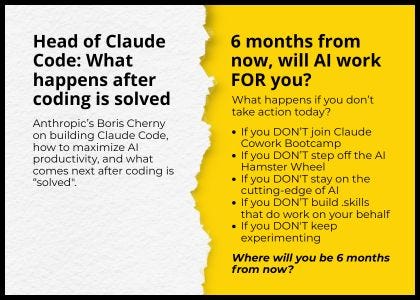
Immediately, No
It would be easy to chalk my reaction up to not liking pushy sales tactics. And sure, that’s part of it, but it’s not the whole story.
I invest in courses, hire advisors, pay for subscriptions, and buy all kinds of things. I respond to urgency all the time. The key however is that it has to come from someone I trust.
So, what was it that bothered me about the second email? It honestly wasn’t the offer. It was the posture. The framing was future-focused and fear-based: What happens if you don’t take action today? From someone I’d never met. Someone who had never meaningfully been in my inbox. Someone who had not yet established any credibility or relational equity with me whatsoever.
My reaction wasn’t this is interesting. It was something closer to:
How $!#%ing dare you try to scare me into buying from you.
That sentence is about sequence. Not sensitivity.
The Real Reason
Consumer psychology tells us that before taking action, people perform a perceived risk assessment — financial, functional, social, psychological. But in digital environments there’s another layer to consider: relational uncertainty.
Relational uncertainty is the degree to which a person lacks confidence in the nature, intentions, or trustworthiness of another party in an interaction. In face-to-face contexts, we resolve it through body language, reputation, shared social context. But online, those signals are stripped away, and in their place we get design, tone, social proof, and increasingly, AI-generated polish. When those proxies are all we have, the pressure to assess correctly increases. So we scan harder — for familiarity, demonstrated expertise, consistency over time, and tone that matches the actual depth of the relationship.
This is where urgency tactics run into trouble. They serve as decision amplifiers, and amplifying a decision before building trust surfaces risk. Put another way, fear-based urgency from someone with no relational standing doesn’t feel motivating. It feels like pressure from a stranger. And when perceived risk rises, people withdraw.
Yes, It’s A Pattern
This reaction isn’t new to me.
Years ago I signed up for a free trial at a gym with some friends (a rite of passage I suspect many readers have also experienced), and I had to sit down with a very enthusiastic salesperson at the end of the week. His entire job was to convert me.
The good news: he did exactly what he was trained to do: limited-time rate, today-only pricing, gentle but persistent pressure about what committing to my health would mean six months from now. It wasn’t aggressive. It wasn’t even rude. But I remember thinking, get me the #$@! out of here.
My discomfort was apparently written all over my face, because my friends turned it a running joke that they still laugh at whenever I’m in the hot seat.
I didn’t fully understand my own reaction at the time. But I do now. My gut was screaming:
I don’t know you well enough to trust a… single… thing… you’re saying.
The bad news (at least for the sales person): I didn’t join. Not because the gym was bad. Not because the price was wrong. Because the urgency of the pitch had outpaced the relationship — and when persuasion tries to move faster than trust, the gap gets filled with risk. And I walk away from unnecessary risk every time.

If you've been reading Marketing Jam for a while, you know I like to build what I call Purpose Plays into my posts. A Purpose Play is a brief pause for you to step out of the ideas and into your own experience. If you're new here, welcome to the tradition.
Purpose Play
Think about the last time you walked away from something you were interested in. Not because the offer was bad — but because something felt off. What was the signal you were reacting to? Was it the tone, the timing, the assumption of intimacy? What would it have taken for that same ask to land differently?
Why This Matters Today
My gym story was personal. But the dynamic it captures isn’t.
We’ve spent the last two decades living in the digital attention economy — a system where capturing attention was the primary strategic goal. In that environment, urgency worked. Scarcity cut through. Fear grabbed clicks. The metrics rewarded the tactics and the playbook spread accordingly.
But that model is showing its age. Media analyst Evan Shapiro describes the market we are in today as the “affinity economy”: a user-centric era where community, engagement, and genuine passion drive value. The distinction matters:
Attention can be captured. Affinity has to be earned.
And that shift changes how persuasion functions. When audiences have real control — when they can unsubscribe, mute, cancel, or scroll past a post in seconds — urgency without relational equity doesn’t work. It comes off as pushy, and, quite frankly, a little insulting.
Now, put that in context with today’s affinity-driven environment, and the sequence is non-negotiable: credibility first, then urgency. Trust first, then acceleration.
My Point
Urgency is not dead. Scarcity is not dead. Future framing is not dead. They will always work — but they need to be used at the right moment in the right relationship.
When a brand deploys one of these tactics too early, it can look like the audience is pulling back. This reaction gets misread as indifference. But it’s not indifference. It’s withdrawal due to a lack of relational equity. And the difference matters enormously.
Indifference means the audience was never interested. Withdrawal means you had them — and lost them by moving too fast. In an attention economy, you could recover from that. Reach and frequency could get you back in front of someone. In an affinity environment, trust compounds slowly over time and erodes quickly. It doesn’t however reset on demand.
The bottom line: You can earn the right to urgency, but you can’t assume it.
Purpose Play
Think about the last time you deployed urgency in your own marketing: a deadline, a limited offer, a fear-framed email. Where were you in the relationship with that audience? Had you established enough credibility and consistency for that ask to feel earned?
What It All Comes Down To
The right to urgency isn’t granted by confidence or good copy. It’s built slowly, through consistency, through demonstrated expertise, and through showing up in a way that earns the next interaction before you ask for it.
When brands skip that work and lead with pressure, the audience goes into assessment mode. They instinctively search for credibility markers and disengage when the ask feels bigger than the relationship. Not out of disinterest. Out of self-preservation.
The psychology isn’t complicated — but waiting to build trust and affinity before attempting to accelerate conversion apparently is.

About the Work
I’m Amy Zwagerman—brand strategist, fractional CMO, and founder of The Launch Box. I work with founders and marketing leaders to translate durable marketing principles into strategies and systems that fit their specific context, stage, and goals.
Marketing Jam sits alongside my client work as a place to explore ideas more openly. If the thinking here resonates and you’re curious about working together, you can learn more about my services or get in touch here.
AI-supported, human-led. All ideas and insights are my own. Curious how I use AI and where I draw the line? See my AI Disclosure Policy →
Integrity Pledge 🙋🏻♀️: The books, newsletters, shows, podcasts, and client work shared here are 100% reflective of my world. I will always disclose if and when I have a relationship with a brand I mention in a post or am sharing an affiliate link.
Great read Amy.