


→ This is a story about the one input AI can’t generate for itself.
TL;DR
AI defaults to the statistical average of everything it's seen. Without brand strategy as a constraint, it will optimize for what's probable — not what's distinctive. The fix isn't a better prompt or tool. It's moving your brand controls upstream, before AI ever touches the work.
The Problem Everyone’s Talking About
You’re using AI to write marketing copy—emails, social posts, landing pages, campaign messaging. It’s fast. It’s grammatically correct. But when you read it back, something’s off. It feels… flat. Generic. Like it could’ve come from any of your competitors.
You tweak the prompt. You add more detail. You try a different model. Same problem. The output is fine. It’s just not you.
Most people assume the issue is the tool. “ChatGPT isn’t good at brand voice.” “I need better prompts.” “Maybe I should try Claude instead.” But AI isn’t the issue. The issue is treating AI like it replaces the process instead of what it actually is: a new creative partner in an old architecture.
Brand strategy has always been the first input required to do good marketing work. The difference now is that instead of handing it to an agency or copywriter, you’re handing it to AI.
The inputs haven’t changed. The architecture has. And if you’re skipping the first step—defining what makes your brand distinct—AI will default to what makes you average.
Why AI Defaults to Generic
AI was built to be helpful, responsive, and resourceful. Its job is simple: predict the next most likely word (or “token”) based on everything it’s seen before.
Ethan Mollick, a Wharton professor and one of the clearest thinkers on how AI actually works, puts it bluntly:
“The most important thing to know about hallucinations is all AIs do is hallucinate. They don’t have truth.
All they do is predict the next word in the sentence.” 1
This isn’t a flaw. It’s how the system works.
AI models are trained on massive datasets scraped from the public internet—articles, blog posts, marketing materials, social media, forums, everything. This gives AI access to patterns in human language at enormous scale.
The good news: AI has learned the structure of human thought and communication. It can mimic tone, style, format, and context remarkably well.
The catch: It’s also learned the structure of marketing copy, and it optimizes for what’s most probable, not what’s most distinctive.
AI is designed to be agreeable. It wants to give you an answer even if it doesn’t have the full context. So when you ask it to “write a blog post about X,” it’s pulling from thousands of similar blog posts. The result? You get the statistical average of all of them. Safe language. Industry buzzwords. Vague value props (“we help you succeed,” “innovative solutions,” “best-in-class”).
AI also doesn’t know your brand unless you teach it. If you haven’t defined what makes you different—your positioning, your voice, your non-negotiables—it will default to what makes you the same.
This isn’t a bug. It’s probability. AI gives you what’s likely, not what’s distinctive. Distinctiveness requires constraints.
What "Good" AI Output Requires
The marketing teams getting sharp, on-brand AI outputs aren’t using better tools. They’re using better inputs.
Governance is now the #1 barrier to scaling AI—not capability, not access, but the lack of clear constraints. But here’s what’s interesting: high-performing teams don’t see governance as a bottleneck. They see it as the unlock. 2
What high-performing teams are doing differently:
They anchor AI to brand voice guidelines (pre-approved tone, language, positioning)
They use claims libraries (messaging that’s already been vetted and reflects their POV)
They treat brand strategy as the governance layer—the filter that tells AI what’s on-brand and what’s off-limits
The bottom line: Brand strategy isn’t decoration. It’s the thing that keeps AI from defaulting to the marketplace average.
AI amplifies what you put in. If you put in vague direction, you get vague output. If you put in sharp strategy, you get sharp output.
How to Use Brand Strategy as AI Governance
When I started integrating AI into my writing workflow, I didn’t just start prompting and hope for the best (well, maybe I did, but I’ve come a long way since then). I treated it like architecture and built a system that would compound over time.
Here’s my process:
Step 1: Defined Writing Style: I used AI to analyze samples of my writing and identify patterns—sentence structure, rhythm, vocabulary, tone. This wasn’t about having AI “write like me.” It was about establishing a baseline so I could teach AI to recognize what my voice actually sounds like.
Step 2: Created a Copywriting Partner: I built a custom GPT governed by my brand strategy and writing style. This GPT serves as my creative writing partner. It acts as a collaborative copywriter that frames my ideas within the constraints I’ve defined. I refine this GPT regularly as my voice evolves.
Step 3: Added a Review Layer: I created a second editorial GPT. This one has different parameters than the copywriting partner: optimize for length targets, manage cognitive load, and maintain tonal consistency. It pressure-tests drafts to make sure they’re sharp (I’ll admit it—I tend to write long and need the help).
Step 4: Mapped the Workflow: I took a giant step back and outlined the actual writing process that evolved from this work—ideation, outlining, drafting, refining, editing, and posting—and identified where AI does and doesn’t add value. Then I updated the entire system based on what I learned.
Psst → My Step 4 should actually be your Step 1. Like I noted earlier, I’ve come a long way since AI first came on the scene.
In the end, AI doesn’t write for me. It works with me. And because I built the architecture first—defining the brand strategy, the voice, the constraints—the output is distinctly mine, not generic.
My Writing Workflow: Before and After AI
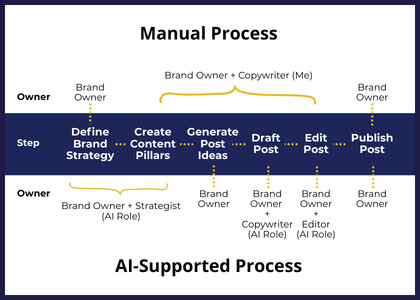
The architecture of my writing process hasn't changed. I am still the person responsible for creating a post (even when I give myself different job titles). I have however made AI a creative partner that helps me execute the work — faster, iteratively, and within my constraints.
What This Means for How you Build
If you’re serious about using AI in your marketing workflows, brand strategy can’t be an afterthought. It has to come first.
The most advanced marketing teams have moved beyond experimentation into what Jasper calls an “operational era”—the point where guardrails, controls, and policies live inside the system itself. When brand strategy is embedded as governance, trust becomes the default. Teams don’t have to slow down to ask, “Is this OK?” They can move fast because the filter is built in. 2
Everyone has access to the same AI tools. The differentiator isn’t who uses AI. It’s who uses it with intention—because they know what they’re protecting.
I like to include what I call Purpose Plays in my posts. You should think of them as brief breaks in the story for you to reflect on how the themes being presented align (or not) with what you're actually building.
Purpose Play
Think about the last time you used AI to create brand copy. How many rounds did it take you to get something usable? What were you correcting for—clarity, or fit? Do you think you could have avoided the issue by providing your brand constraints up front?
AI is incredible at producing marketing copy. But it’s terrible at making brand decisions.
If your outputs feel generic, don’t blame the tool. Ask yourself: have I actually defined what makes my brand different? Or am I hoping AI will figure it out for me?
Build the filter first. Then let AI work within it.

Sources
1 Mollick, E. (2024). Co-Intelligence: Living and Working with AI. Portfolio.
2 Jasper (2026). The State of AI in Marketing 2026.
About the Work
I’m Amy Zwagerman—brand strategist, fractional CMO, and founder of The Launch Box. I work with founders and marketing leaders to translate durable marketing principles into strategies and systems that fit their specific context, stage, and goals.
Marketing Jam sits alongside my client work as a place to explore ideas more openly. If the thinking here resonates and you’re curious about working together, you can learn more about my services or get in touch here.
AI-supported, human-led. All ideas and insights are my own. Curious how I use AI and where I draw the line? See my AI Disclosure Policy →
Integrity Pledge 🙋🏻♀️: The books, newsletters, shows, podcasts, and client work shared here are 100% reflective of my world. I will always disclose if and when I have a relationship with a brand I mention in a post or am sharing an affiliate link.