


→ This is a story about what happens when we judge each other by standards we never actually named.
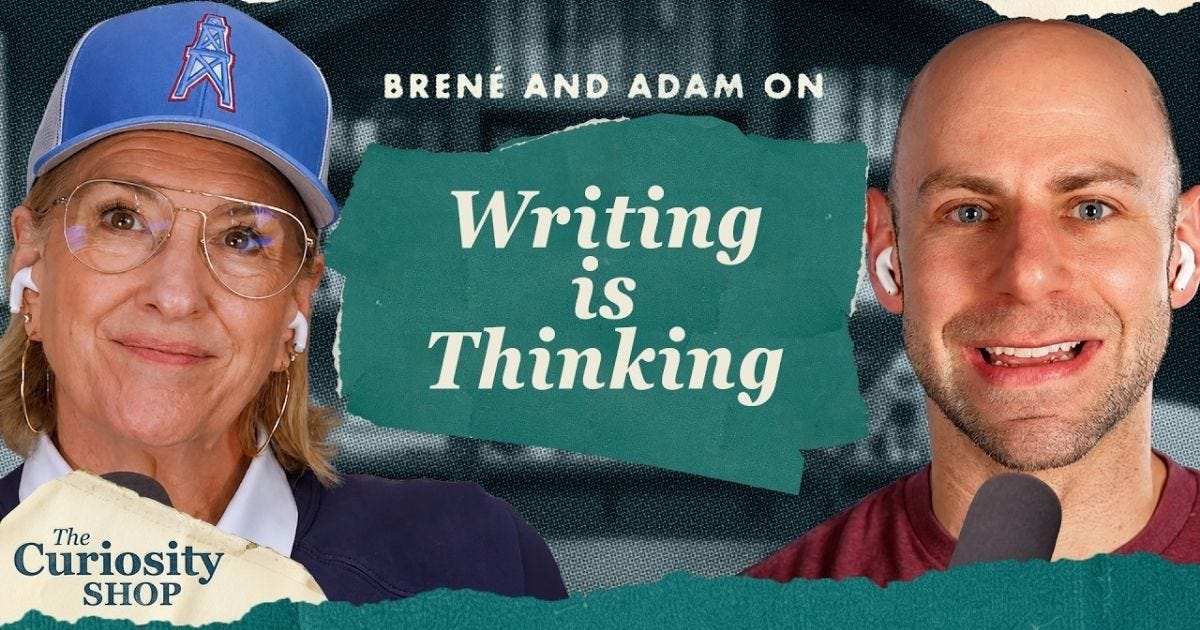
Everyone agrees AI slop is a problem, but almost no one agrees on what it actually is. This post looks at new research on AI workslop, my own study on AI-mediated leadership communication, and an unscripted moment between Brené Brown and Adam Grant to make the case that slop is not about the technology, but our individual standards.
I keep seeing the same word everywhere: SLOP. As in AI Slop, workslop, content slop. Call it whatever you want.
Slop has become shorthand for everything wrong with generative AI, and lately it feels less like a critique and more like a pile-on. A whole cultural mood, aimed at the technology, as if the technology is the thing doing something wrong.
My POV: It isn’t. I’ve said it before and I will keep saying it: generative AI is not the problem. People are.
Slop is a standards problem. Technology (the internet, social media, and AI) just made it visible.
The research backs this up, but let’s start by establishing a common vernacular:
AI workslop: AI generated work content that masquerades as good work, but lacks the substance to meaningfully advance a given task (BetterUp).1
Now, given the above construct, let’s look specifically at workslop. BetterUp, in conjunction with researchers at Stanford’s Social Media Lab surveyed over a thousand full-time desk workers and found that 40% felt they had been handed “workslop” in just the past month. The fact that stopped me cold, however, wasn’t the amount of workslop, the time wasted, or even its cost. It was this: the workers who received it didn’t just get annoyed. Nearly half quietly downgraded how creative, capable, or reliable they thought the sender was, 42% saw them as less trustworthy, and 37% saw that colleague as less intelligent.1 In other words, we’re all sitting around silently judging our coworkers because their work isn’t up to our standards.
I also find it interesting that we haven’t clearly defined what workslop is. From the perspective of the BetterUp study, “lacks the substance to meaningfully advance a given task” is an attempt to do so, but the language leaves a lot of room for individual interpretation: one person is sure to have a different opinion than the next.
This idea is similar to something I discovered while studying AI-mediated leadership communication for a presentation I gave this June. As background, I ran in-depth interviews with business leaders — all users of generative AI with attitudes ranging from enthusiastic to reluctant — across industries, and the one thing they all had in common was a desire to make AI-assisted output feel like them.
“Even with the final draft that AI will produce, I will still go in and edit elements of it so that it sounds even more like me.” Participant 01
Each participant, however, decided when it was and wasn’t ok to use generative AI, what standards they applied when using it, and how to meet that standard differently. Put another way, they weren’t thinking about how the work would be perceived, but how to ensure it met their personal standards for doneness.
The authenticity work people are doing with generative AI is self-directed before it is audience-directed.
They are not managing detection. They are managing integrity.
What that means is we are applying independent judgement to decide both when our work is done and how others work stacks up against it.
Here is another example that played out over my headphones recently.
As background, I had a few free hours to burn the day before I was set to give the presentation I mentioned earlier, so I opened up my phone, hit play on an episode of The Curiosity Shop with Brené Brown and Adam Grant, and went for a walk.2
What happened next was like the scene in a movie where the hero magically gets handed exactly what they need to land the perfect job, get the man (or woman) of their dreams, or save the day. My hero moment just happened to be listening to two scholars talk about exactly what I had researched for the past 3 months. I was giddy as they started dissecting their feelings about workslop.
The net of Brené and Adam’s (can I call them by their first names?) conversation: they were both bothered by AI workslop, but they were not bothered by it for the same reason.
Same term. Two completely distinct perspectives.

Brené is talking about meaning-making from a researcher’s perspective. The effort required for a piece of work to be ready for consumption, or as she calls it, paint done. Adam is speaking as an author: words are his meaning-making and the act of writing them is sacrosanct.
They are expressing two completely different ideas about what qualifies as AI workslop, each built in alignment with their sense-of-self, created over a lifetime of work.
Agreement around the term itself just made it sound, for a moment, like they had a shared understanding of its meaning.
That’s the actual cost of this conversation. Not the quality of the work, but that a private, individually-built standard keeps getting treated as if it were shared and self-evident.
Technology takes the blame out loud, the person takes the judgment we apply, and the standard itself, the only thing actually missing, never gets named at all.
For their part, Brené and Adam arrived at this same conclusion because they took the time to explore the problem, out loud, with each other.
Welcome to Purpose Play. For those who are new here, it’s a quick pause built into my posts — a moment to step back from the ideas and check them against your own work. This one’s personal: we're not looking at Brené and Adam’s standards. We're looking at yours.
Purpose Play
Part 1. What do you believe “paint done” actually looks like for your own output? Not what you would say the standard is in public. What was it for the last thing you created? Do you have a different standard depending on what it is — a social media post, blog story, work you are handing in?
Part 2. How do you decide when something you are reading, watching, or listening to is trustworthy? Do you have different expectations depending on where you encounter the content (social media, online, at the office)? Are you judging the person who made it based on your standards?
Look, I’m not saying that slop doesn’t exist. It does. What I’m saying is that slop itself is not the problem. It’s just the word we reach for because it is easier to say out loud than the truth underneath it.
We’re all working from a definition of “done” nobody else can see, built over a lifetime, and we keep assuming everyone else is reading from ours.

Related Posts
AI Slop is About the User, Not the Technology
You Don’t Have an AI Problem, You Have a Brand Clarity Problem
How AI is Changing the Shape of Marketing Work
Sources
BetterUp (2025). “Workslop: The Hidden Cost of AI-generated Busywork.“
Zwagerman & Granados (2026). AI-Mediated Leadership Communication.
The Curiosity Shop with Brené Brown and Adam Grant (2026). “AI, Commencement Speeches, and Why Human Thinking Still Matters”
About the Work
I’m Amy Zwagerman—brand strategist, fractional CMO, and founder of The Launch Box. I work with founders and marketing leaders to translate durable marketing principles into strategies and systems that fit their specific context, stage, and goals.
Marketing Jam sits alongside my client work as a place to explore ideas more openly. If the thinking here resonates and you’re curious about working together, you can learn more about my services or get in touch here.
AI-supported, human-led. All ideas and insights are my own. Curious how I use AI and where I draw the line? See my AI Disclosure Policy →
Integrity Pledge 🙋🏻♀️: The books, newsletters, shows, podcasts, and client work shared here are 100% reflective of my world. I will always disclose if and when I have a relationship with a brand I mention in a post or am sharing an affiliate link.
I really appreciate how you are proving context for critically consider the purpose and function of A.I. Compared to tech bros who focus on sales mode talking points. Even now I am unclear on the on how the function of it is best utilized. I keep falling into the costs of using it and my limited ability to make anything from it that balances it out.