


→ This is a story about the costs of putting tactics before strategy.
TL;DR
I spent years building a business before I was clear and paid for it in friction and fatigue. This post is about what it costs when tactics drive strategy, why brand must come first, and how using it as a filter changes how — and what — you build.
If you’ve ever built something that looked right but felt wrong, this is for you.
FADE IN
INT. APARTMENT—DAY
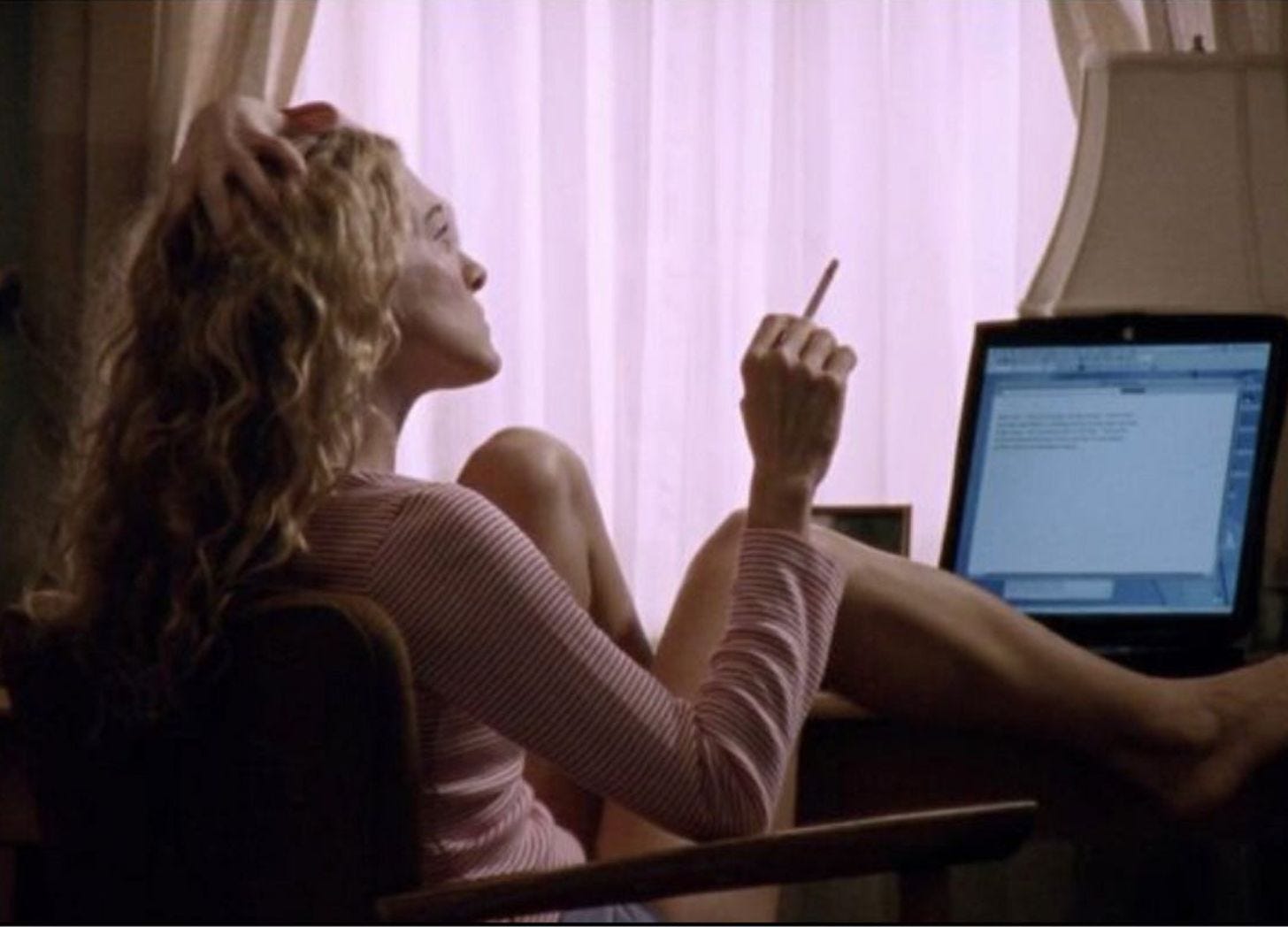
A woman sits at a desk in her apartment, staring at an open laptop. The room is lived-in and warm—think Carrie Bradshaw’s West Village brownston ala Sex in the City. A coffee mug sits forgotten to her left.
FIRST PERSON VOICEOVER:
I’m going to share a dirty little secret with you. It took me over five years to produce a complete brand strategy for my business. Not because I don’t know how. I literally help other people do this. Not because I didn’t have time. But because every time I sat down to write it, I’d freeze. The words wouldn’t come. I’d write a few lines, step away, come back, hate everything, and move on to something else.
For a long time, I told myself it was fine. I was busy. The work was good. Clients were happy. I’d get to it eventually.
But here’s what was actually happening: I was trying to wrap a brand around decisions I’d already made. I was stuck because those decisions weren’t connecting on a strategic level. I’d turned the exercise into a way to justify my choices.
Uh-oh.
I was sitting squarely in ‘Do As I Say, Not As I Do Territory’.
I’d turned my own brand strategy into a pat-on-the-back exercise, and, quelle surprise, it wasn’t helping me move forward.
Close-up on the woman’s face as realization dawns. Camera pulls back as she closes the laptop and stands.
FADE OUT
Were you in the scene with me? I hope so. I really tried to bring the drama.
Now, let me take a step back and tell you what I’m talking about.
What is brand strategy, anyway?
Brand strategy isn’t your logo. It isn’t your color palette. It isn’t even the aesthetic layer you apply once the “real work” is done.
It’s the set of decisions that shape everything that follows — your positioning, your messaging, the promises you make (and refuse to make). It’s the lens through which you evaluate ideas before you build them.
Here’s what that looked like IRL:
A few years ago, I became convinced I needed to launch a course. I was obsessed with the model—scalable, repeatable, one-to-many. I did a deep dive on how to build a successful course. I built what I genuinely thought was a great program, designed a beautiful landing page, and presented it to the world.
Crickets.
So I pivoted. Ran a small in-person test with ten people. And that’s when it hit me: what makes my work different—what makes it really good—is the high-touch, one-on-one process I go through with my clients to build their brand strategies. And trying to package that into a one-to-many model doesn’t work. It’s not what I do.
But I didn’t realize that until after I’d built the whole thing. Uh-oh (again).
The good news: the version of my brand that I have today—the one that actually works—is 100% brand-strategy-first.
I know exactly what the business is, who it’s for, what I stand for — and just as importantly, what I don’t. And when a new idea shows up—which they always do—I don’t build it first and figure out the brand fit later.
I run it through the filter:
Does this align with the business I’m building?
Does it serve the people I want to serve?
Does it reflect the work I actually want to be doing three years from now?
If the answer is yes, great. Put it on the road map. If the answer is no—even if it’s a really good idea—let it go (at least for now).
The end result: my days are more focused and my brand, well, it feels like me.
If you’ve been reading Marketing Jam for a while, you know I like to drop what I call Purpose Plays into my posts — little moments for you to step outside of the story and think about your own life and work. If you’re new, consider this your introduction.
Purpose Play
Think about the last thing you built or launched in your business.
How did it feel while you were building it?
Was there momentum — or resistance?
Did decisions stack — or did you find yourself constantly recalibrating?
Now turn your attention to what you’re considering next.
Why do you want to build it?
How does it connect to the broader direction of your business?
If nothing changed financially, would you still want to be doing this three years from now?
As you answer, notice how you feel about the question. The feeling is often the tell.
So, what’s the big deal?
The cost of building first and justifying later is real — and it’s exhausting. Nothing stacks. Every pivot resets the clock. And over time, that friction compounds.
Here’s my point: brand clarity comes before you build, not after. When you do it in that order, everything shifts. You’re not second-guessing fit. You’re not rewriting the same message five ways. You’re not pivoting every six months. You know what belongs—and what doesn’t.
That’s what ‘brand isn’t a wrapper, it’s a filter’ actually means.
So, stop wrapping your brand around your ideas. Start filtering your ideas through your brand. Build the strategy. Then build the thing.
It’ll feel like you. You can’t do better than that.

About the Work
I’m Amy Zwagerman—brand strategist, fractional CMO, and founder of The Launch Box. I work with founders and marketing leaders to translate durable marketing principles into strategies and systems that fit their specific context, stage, and goals.
Marketing Jam sits alongside my client work as a place to explore ideas more openly. If the thinking here resonates and you’re curious about working together, you can learn more about my services or get in touch here.
AI-supported, human-led. All ideas and insights are my own. Curious how I use AI and where I draw the line? See my AI Disclosure Policy →
Integrity Pledge 🙋🏻♀️: The books, newsletters, shows, podcasts, and client work shared here are 100% reflective of my world. I will always disclose if and when I have a relationship with a brand I mention in a post or am sharing an affiliate link.
This is one of the most important perspective-shifts I’ve read about in a long time. The right brand strategy can filter out so much unnecessary effort and spending.
Halfway through line editing, and I'm going to have to do a bit more after that. Someday! Thanks for asking, Amy.