


→ This is a story about seeing the system that was hiding in plain sight.

TL;DR
Most people experience marketing as a menu — a collection of disciplines to choose from, each one promising results, none of them quite connecting. This post offers a different frame: marketing is a system of systems. It always follows the same underlying logic, and once you understand it, all of the pieces just fall into place. AI didn’t create the system. It just made it a lot more obvious.
Everything is a System
There’s a moment — if you’ve ever tried to seriously integrate AI into your work — where something shifts.
You sit down to hand a task to a system and realize you can’t. Not because the tool isn’t capable, but because you can’t explain what you’re actually doing clearly enough to teach it. You don’t know the sequence. You don’t know what depends on what. You’ve been operating on instinct so long that the logic of your own work has become invisible to you.
That moment is uncomfortable. It’s also one of the most clarifying things that can happen to a marketer right now.
Because what AI is quietly forcing all of us to do — founders, operators, marketers, builders — is see the system underneath the work.
Draw the diagram. Name the layers. Understand what has to be true before the next thing can function.
And once you start doing that, you can’t stop. It becomes glaringly obvious: everything is a system. Your content workflow is a system. Your go-to-market motion is a system. Your customer acquisition strategy is a system. And all of those systems sit inside a larger one: your marketing operation as a whole.
The Code Behind the Disciplines
Here’s what the marketing advice ecosystem looks like from the outside: an endless feed of experts, each one making a compelling case for their own thing. Brand. Content. Go-to-market. Growth. Every lane has its champions. And every champion is, within their lane, correct.
What nobody shows you is the code running underneath all of it.
Marketing isn’t a menu of disciplines to choose from. It’s a system. A set of interdependent layers where what you build first determines what’s possible later.
The disciplines aren’t competing options. They’re the visible surface of something that has structure, sequence, and logic. A logic that operates whether you see it or not.
So, I am asking you to follow the white rabbit, take the red pill, and start seeing the system that runs everything. (Yes, I’ve made myself Morpheus in this Matrix-themed analogy. That means you are Neo.)
The Layers — And Why Order Matters
Let’s make the system visible.
Exhibit 1. Layers of the Marketing System
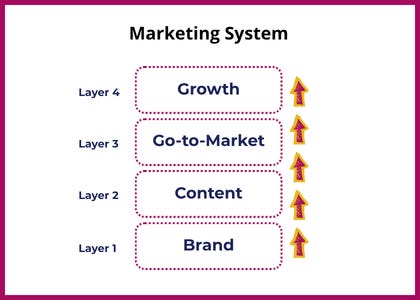
Brand is the foundation. It defines who you are, who you’re for, what you stand for — and just as importantly, what you don’t. It’s the layer that tells every other part of your marketing operation what it’s working with. Without it, you’re not making marketing decisions. You’re making guesses that occasionally work and wondering why you aren’t seeing more progress.
Content is how your brand thinks in public. It’s the expression layer — the ongoing articulation of your point of view across channels and formats. This is where tactics like social media, long-form content, and SEO live. Content only works when it has something real to draw from. Brand gives it that. Without a clear brand underneath it, content becomes an endless production problem — you’re always asking “what should we post?” instead of “how do we say what we already know to be true?”
Go-to-Market is how you take a specific offer to a specific audience at a specific moment. It borrows from both brand and content — the positioning, the voice, the proof points, the channels where your audience already lives. A go-to-market strategy built without those layers underneath it is just a launch plan. And launch plans without strategic underpinning tend to underperform.
Growth is the acceleration layer. Paid media, SEO investment, lead generation, conversion optimization — these are the tools you use to pour fuel on what’s already working. Which means they require the other layers to be working first. The math doesn’t lie: when your cost per acquisition keeps climbing and your conversion rates stay flat, the problem is almost never the ads. It’s what the ads are pointing to.
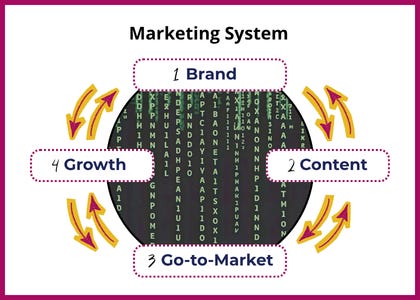
The sequence itself isn’t rigid. Real businesses don’t build in perfectly ordered phases — you iterate, you revisit, you refine. But, once the system is running, the sequence becomes a cycle. Brand informs content. Content surfaces what’s resonating in the market. Market signals inform how you evolve your positioning. Positioning sharpens the brand. The layers don’t just build on each other — they feed each other.
Exhibit 2. Interconnected Marketing System
Why The System Stays Hidden
Marketing has always been taught by discipline. You learn brand strategy from brand strategists. You learn SEO from SEO specialists. You learn growth marketing from digital marketers. Each body of knowledge is deep and legitimate and genuinely useful — inside the right context, at the right stage, on top of the right foundation.
But nobody teaches the sequence. Nobody explains that some of this advice applies to you right now, and some of it applies to a version of your business you haven’t built yet.
Nobody tells you that running growth marketing before you’ve nailed your positioning isn’t a media or messaging problem, but an order-of-operations problem.
So operators do what any reasonable person does when confronted with an abundance of credible, conflicting advice: they pick the thing that sounds most urgent, or most interesting, or most like what their competitors appear to be doing. They execute it earnestly, get inconsistent results, and conclude — quietly, and usually incorrectly — that marketing doesn’t work.
But the tactic wasn’t wrong. The timing was.
What AI Is Clarifying About All of This
When you introduce AI into a marketing operation that has clear architecture — a solid brand layer, a content strategy that draws from it, a go-to-market approach that knows exactly who it’s talking to and why — it works remarkably well. AI can execute within constraints. It can accelerate production, maintain consistency, and scale what’s already working.
On the flip side, when you introduce AI into a marketing operation that doesn’t have that foundation, the gaps become impossible to ignore. Generic output. Messaging that could belong to anyone. Content that’s technically correct and completely unmemorable. Humans have always filled those gaps intuitively — an agency establishes a strategy, a copywriter tweaks the messaging, a founder provides comments because something felt off. But when AI has to fill the gaps, judgment gets lost and the work reads like AI slop.
I learned this firsthand.
When I started mapping my own business — diagramming how the work actually moves, where AI fits, what depends on what — I stopped seeing a collection of tactics and tools and started seeing an integrated system.
A system I had to build from the ground up, starting with my brand. Everything else — the content workflow, the client-facing tools, the social distribution — moved downstream of that. Now, if I decide to change something about my brand, I do it within the foundation layer and everything else shifts. That’s how systems work.
A quick pause before we go further. If you're new here, Purpose Plays are how I connect the ideas in a post to the work you're actually doing. This one's worth sitting with — the layers will start to take shape once you start looking.
Purpose Play
Think about your marketing right now — not the strategy you intend to build, but the one you’re actually running.
Work through the layers from the bottom up and answer honestly:
Do you have a brand strategy — a clear articulation of who you are, who you’re for, and what you stand for?
Does your content have a strategic logic underneath it, or is it driven primarily by what you feel like posting, writing, or talking about?
When you take an offer to market, do you have a deliberate go-to-market approach — specific audience, specific moment, specific message?
Are you trying to scale or grow? If so, what part of your business are you trying to accelerate? Did you already validate the approach?
→ Marketing Tip: You don’t need to be running all of the systems. Just knowing which layer you’re on — and which ones you may have skipped — is the most clarifying thing you can do right now.
Free Your Mind
My point: If you take anything away from this post, know that marketing doesn’t feel overwhelming because you’re doing it wrong. It feels overwhelming because you’ve been handed the pieces without any instructions about how they relate.
Here’s what changes when you understand that: you stop asking “which of these things should I be doing?” and start asking “where is my system breaking down?”
That’s the question that actually moves things forward.
You can see where you are. You can see what’s missing. You can see what’s ready to move and what isn’t.
And, once you see that, you can’t unsee it.

About the Work
I’m Amy Zwagerman—brand strategist, fractional CMO, and founder of The Launch Box. I work with founders and marketing leaders to translate durable marketing principles into strategies and systems that fit their specific context, stage, and goals.
Marketing Jam sits alongside my client work as a place to explore ideas more openly. If the thinking here resonates and you’re curious about working together, you can learn more about my services or get in touch here.
AI-supported, human-led. All ideas and insights are my own. Curious how I use AI and where I draw the line? See my AI Disclosure Policy →
Integrity Pledge 🙋🏻♀️: The books, newsletters, shows, podcasts, and client work shared here are 100% reflective of my world. I will always disclose if and when I have a relationship with a brand I mention in a post or am sharing an affiliate link.
This is what I call Shiny Marketing Tactic Syndrome exposed.
It also lays out the fundamentals in a new way. Fundamentals appear boring. But getting the gears to work can be utterly fascinating too.
I’ve read a ton about marketing but seeing it as a system with dependencies is exactly what I needed. Thank you for writing this.